
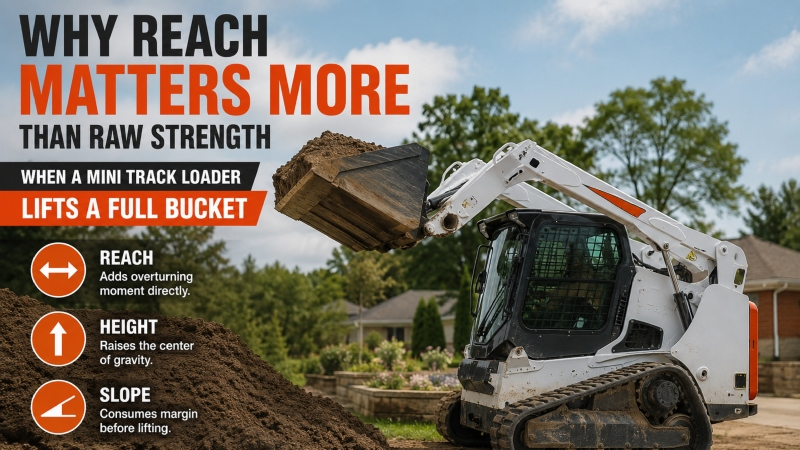
Canadian landscaping crews are deep into the busiest weeks of the season, moving topsoil, gravel, and mulch from a driveway pile to wherever it is needed. A mini track loader does most of that carrying, and nearly every incident traces back to one question: how far the material sits from the machine.
Hold a brick against your chest, then at full arm extension
The brick never gains weight, yet the second position is far harder. What changed is the moment: weight multiplied by horizontal distance from the shoulder. A mini track loader behaves the same way. The pivot is the front edge of the tracks, and a full bucket held beyond the arms creates an overturning moment that grows with reach.
Rated capacity is deliberately a fraction of tipping load
Manufacturers first measure the static tipping load: the weight at a defined load center that lifts the rear of the machine off the ground. That is a limit, not a working target. Rated operating capacity sits well below it, preserving margin for uneven ground, shifting material, and the forces of driving and braking.
Counterweight and track length supply the answering moment
Resisting all of this is mass behind the pivot. Engine, frame, and any factory counterweight sit toward the rear, each contributing weight multiplied by its distance behind the front rollers. Track contact length matters because it sets where that front pivot line falls. A longer contact patch places the tipping edge farther forward on a mini track loader, lengthening the resisting arm.
Lifting high is not the same danger as reaching far
On level ground, raising a bucket straight up barely changes the overturning moment, since the arithmetic uses horizontal distance. What it does change is the height of the combined center of gravity.
A higher center of gravity means a smaller tilt carries the balance point past the track edge. That is why a mini track loader feels honest on flat pavement and treacherous doing the same work across a slope.
- Reach: adds overturning moment directly
- Height: raises center of gravity
- Slope: consumes margin before lifting
The habits follow. Carry material low and close to the frame, travel with the heavy end uphill, and turn on a grade slowly and wide, since a sharp turn shifts weight sideways when margin is smallest.
On a sloped Ontario lot, crew filling raised beds approaches with the bucket scraping grass, lifting only when tracks square. Treating it as a lever, not a lifting contest, makes mini track loader predictable, while keeping material low protects margins.
Looking forward to more information.