
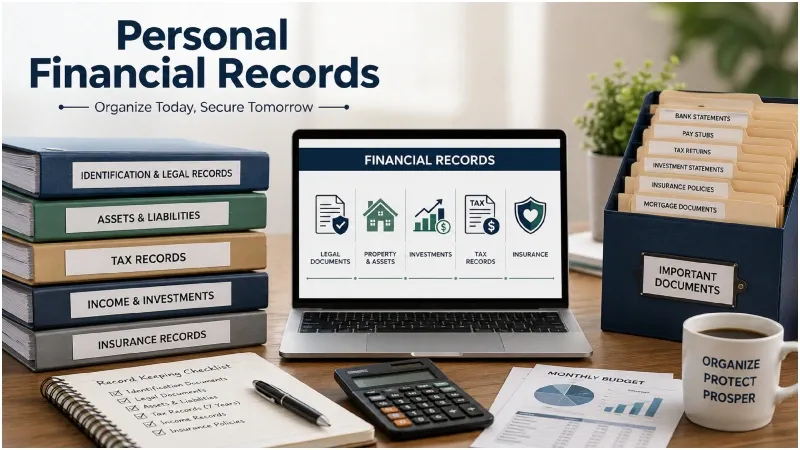
One of the keys to a successful outlook is making sure you understand exactly which records you need to keep to ensure you have everything you need for your personal financial records. There are several types of records that we’ll outline, and different types of documents fit into different categories.
This article will outline the permanent records that you must keep forever for identification and legal purposes, those that help identify your current assets and liabilities, as well as the specific documents required for tax purposes in case of an IRS audit. Whether you want to keep a paper-based or a cloud-based filing system is up to you, but the benefits of keeping all your documentation digitally are that your files can be available to you anywhere at any time.
Some records you must keep permanently
Whilst it might seem a touch confusing at first, one of the key elements in understanding your personal financial records is to realise that there are several documents that you already hold which don’t directly correlate with your finances but that make up crucial elements of this bigger picture. These documents are associated with your identification, as well as the legal documents that cover aspects of people’s estates.
The reason we refer to these documents as permanent records is that they are incredibly difficult to replace if you were to lose them. You should always make sure you have your birth certificate, the death certificates of loved ones whose estates fall under your control, Social Security cards, passports (both current and expired), any citizenship papers, and marriage licenses or divorce decrees.
In terms of legal files, you should keep any written documentation of wills, trusts, living wills, and powers of attorney at all times. You may even still require these documents for years after the person bequeathed their estate to you, so you should hold onto these as a paper trail for eternity.
One final permanent record that may apply to you is your military service. You must retain any discharge documents (DD214) or military records that you are handed, as these can be required to attain certain types of ex-military benefits. As these documents are essentially irreplaceable, you must keep them for the rest of your life.
Keep recorded all of your active assets and liabilities
The second type of documentation category is your currently active assets and liabilities. These mostly correspond to your property, investments, and insurance. All of these documents must be kept for the entire time you own the asset. They can be discarded and destroyed once the period of ownership ends, but you must keep any new documentation for replacements in the same way.
Starting with property, you must keep the following types of documents for the entire length of your ownership: house deeds, mortgage and closing documents, home improvement records (as these would be used to align with any capital gains tax requirements), and vehicle titles. Specifically for your car, this should also include the registration, proof of insurance, warranty, and servicing records.
In terms of investment records, you should keep any brokerage statements, retirement account records (which most people refer to as their 401K), and any stock records, too. When it comes to insurance, you should always keep handy any current coverage policies for your home, contents, auto, and life. What we mean by current is that you should keep insurance policies as long as you’re still making payments on them and that the coverage is active. When your policy ends, you can destroy your previous paperwork and replace it with your renewed or replaced documentation.
All tax-related documents should be held for seven years
Turning to tax, let’s start by making it clear: different tax documents require you to hold onto them for different lengths of time. However, you must keep your tax returns on file every year for the duration of your life. This is good practice, and also protects you in case the IRS calls you for an audit. Overall, the IRS generally recommends keeping documentation for 3 years, but most resources suggest retaining your records for up to 7 years. This is because the IRS can go back as far as seven years into your tax history, so having as much evidence as possible to prove you paid the correct amount of tax is helpful in your case.
In terms of your income records, the same logic applies to your W-2s and 1099s: the IRS says three years, but most would recommend seven. To be on the safe side, you should also hold your investment income records for this same period of time as well.
Generally speaking, if you have any document that corresponds with your tax returns, you should hold it for the same length of time as those documents. This can include things like charitable donations and medical expenses.
However, you also hold onto some general personal financial records, too. These include your bank statements, pay stubs, and ATM receipts. It is advisable to keep these documents for up to a year in clearly organized monthly files. This way, you can always recall the exact income and expenditure in your personal life for the specific month that may be requested.
Physical or digital record keeping, it’s up to you
You should now have a much clearer picture as to which documents are essential to retain, those that you must hold onto for tax purposes, and those which are just generally good practice to hold onto for a specific time period. Now that you are aware of just how many documents you are going to need to keep hold of, you should be able to make an educated decision as to whether you feel that you can maintain an up-to-date physical filing system or whether you would prefer to retain these documents digitally.
Everyday financial records like your bank statements and pay stubs are usually provided to you digitally nowadays, which tends to sway some people towards keeping all files digitally as a way of saving the trees you’d need to print each document over the seven years.